Pages

Wednesday, July 15, 2015

Non Toxic Ant Bait

It's summertime, that's for sure. I can tell because of the oppressive heat, humidity, bathtub temperature pool water, and long hours of daylight. I can also tell because the ants are out in full force!

image credit: wildlensinc.org


We have our house serviced by regular pest control, but every week when I mow the yard I come across another new anthill or two. I've spot-treated anthills over the years using liquid pesticide sprays and/or granular ant baits, but I've never been totally comfortable with the idea of leaving toxins around the yard in areas where the kids and dog roam.

Recently my brother-in-law offered a more natural solution - an ant bait consisting of baking soda and powdered sugar. The powdered sugar attracts the ants, and the baking soda kills them.


Directions

  • Mix equal parts Baking Soda and Powdered Sugar into a container. I made a bigger batch than I needed, which I stored in a sealed container as ready made bait for the next time I need it.
  • Spread it liberally around the ant-infected area. You don't have to put it right on the mound; they'll find the sweet taste of sugar and bring it back to the colony.
  • Over the next day or two the colony will feast on this bountiful harvest, and the baking soda will kill the ants, including the queen.
  • No Substitutes - powdered sugar and baking soda have a very similar texture; once they're mixed together you can't really tell which is which. I don't think this trick would work as well with granulated sugar, as the ants could pull the sugar granules and leave behind the baking soda.

Results

  • From my own personal experiences, this mixture has worked great on two different ant hills over two different weekends.
  • Next time I come across a colony of mad ants (which shouldn't take too long), I'll take some before and after pictures and update this post.

In the meantime, give this a try at your house and let me know how it goes!

- Chris Butterworth

.

Tuesday, June 30, 2015

Cleaning Pool Tiles

How frustrating is that white, hard water calcium line around the your otherwise clean and refreshing swimming pool?

I've scrubbed at my pool tiles with different types of cleaners over the years, and I've paid hundreds of dollars to have the tiles professionally cleaned, but that white hard-water line always comes back. My brother-in-law offered a suggestion of replacing all the blue tiles with white tiles, but that's not the solution I was after.

Instead I decided this year to talk with the folks at the local pool supply store, who recommended either a chemical bath product to soak in the pool (which I'm not thrilled about trying) or a synthetic pool stone to scrub with (creatively called Pool Stone.)

I decided to give the Pool Stone a try.


The stone itself is light - like a piece of styrofoam, but after it soaks in the pool for 20 minutes it becomes much heavier and harder - more like a pumice stone.

Unlike a pumice stone, though, this synthetic stone works wonders. Sometimes I pressed hard and scrubbed with attitude to aggressively clean a tile in about a minute. Other times (when I got tired) I would rub the stone without much pressure at all and it still managed to clean a tile, although it would take two or three times as long per tile.

I didn't take a "before" picture of my pool, honestly because I didn't expect this stone to work any better than anything else I tried, and I didn't expect this project to go so quickly and smoothly. But here is a picture of one section of the pool tile after I had scrubbed a handful of tiles:


Here is another section of the pool where the tiles are mostly done:


And finally, here is a side of the pool where all the tiles look blue again:


This is one of those DIY projects that isn't difficult at all, and which can save you a ton of money compared with having a professional do it for you. A few extra thoughts and tips regarding the process:

  • Slow and Steady - my pool has 186 tiles around the perimeter (if I counted correctly), so this wasn't something I could knock down in a day. I spent 20-30 minutes at a time over the course of a few weeks, cleaning 8-10 tiles in a session, before the whole pool was calcium line free.
  • Clean Completely - the big thick white line usually comes off in just a few seconds, but if you look closely you'll see a smaller, fainter line as well. Many of the tiles also had a faint line under the water line. Whenever I didn't clean the tile completely, these faint lines showed up the next day and stood out from the "clean" tiles. I learned quickly to clean the tile completely if I wanted to have shiny clean tiles.
  • Pool Stones wear away - I think I used up 5 Pool Stones during this project. At $10 each that's a chunk of change, but it's a fraction of the cost of a professional cleaning service.
  • Soak the Stone - the stone will wear out very fast if you use it before it's soaked full of water.
  • Maintenance - I'm going to buy a couple extra Pool Stones to have on hand; maybe I'll be proactive enough to scrub the tiles before they get really bad so I don't have to do this major clean up again in 2018.
  • Wear Gloves - I scrubbed the first two days with bare hands, and on the third day my thumb was worn just about raw. I wore work gloves for the rest of the project and didn't have any other problems.


And that's all there is to it.

I'd love to hear if you have a different / better way of keeping your pool tiles clean, of if you give this a try and it works for you too.

- Chris Butterworth

.

Tuesday, February 10, 2015

What to expect from the market in 2015

The trouble with trouble is that you can't always see it coming; things will be going along just fine, until they aren't. And then it's too late. And then you're in trouble.

I'll start this post off by admitting I really don't know for sure what to expect from the market this year. (it seems like I say that every year lately). But I do have some concerns about headwinds (I've been saying that for a couple-few years too).

Let's take a look at some current local and global economic trends to see if we can discern what we might have in store...

Market Momentum

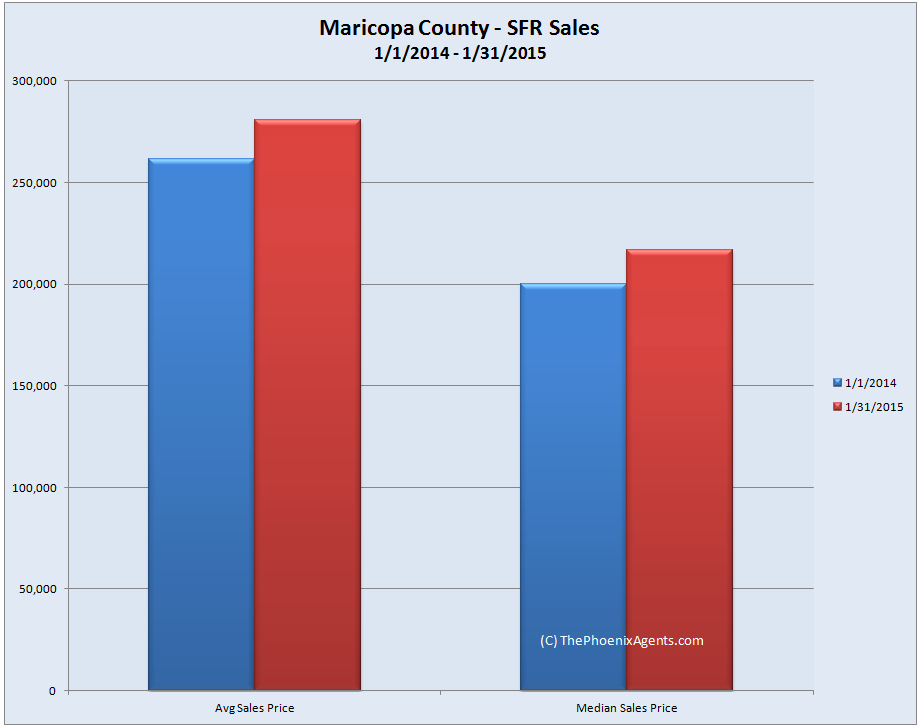
Local real estate prices are up about 10% - 15% over the last couple of years, or about 5% - 7% per year. That's a little too fast to be sustainable, but rising prices are generally considered a good thing. Buyers are more confident in their purchase, and even a little bit motivated to make an offer before prices go up again. Sellers gain confidence from knowing what they'll be able to net based on recent sales, as opposed to a falling market where sellers either panic or stay put.

(click on any chart or image to embiggen)

Maricopa County SFR Sale Price year over year


ARMLS sales data
sales data provided by ARMLS and is deemed accurate but not guaranteed.


However, market momentum only goes so far. Momentum can be fickle, and when it changes it can change on a dime.

Interest Rates

Interest rates are low. Very low. All time, record setting, once in a lifetime low. I'm not going to predict rising rates this year - heck, rates might stay where they are for a long time. They might even drop lower.

30 Year mortgage rates


current 30 year mortgage rates
charts provided by the Federal Reserve Economic Data website


But, taking an objective approach, how much lower could they really go? Could we see a 30-year mortgage at 3.0%? 2.5%? Maybe. Rates have been close to zero in Japan for a generation, so there is a precedent. Unfortunately Japan has other problems which are offsetting, or forcing, those low interest rates, and none of those problems are conducive to a healthy real estate market.

On the flip side, it doesn't take much creativity to imagine a 30-year mortgage at 5% or 6%. And the difference?

A $300,000 house with a 20% down payment and an 80% loan ($240,000) will have a monthly mortgage payment of $1,111 at today's 3.75%. That same $1,111 payment could buy a $329,538 house if rates fall to 3.0%, but it can only purchase a $258,810 house if rates rise to 5.0%. (or $231,731 at 6.0%!) - see charts below.


payment on $300,000 house at various interest rates


monthly payment comparison at various interest rates


Interest rates can have a massive impact on our market, and they have more room to rise than fall from where they are today.

Rising Dollar

I'm not smart enough to outline exactly why the Dollar is rising against foreign currencies - something to do with the coming economic problems in Europe and Japan being nearer to the forefront than the problems in the US, so globally people would prefer to hold Dollars rather than Euros or Yen, thinking the former is more likely to hold its value. And of course the price of a good or service (Dollars in this case) will increase with the rise in demand.


charts clipped from google finance

What does this mean for us? Here are is an over simplified example:

Let's say Apple is a US company and sells iPhones for $500. And let's say Samsung is a South Korean company who sells Galaxy phones for 500,000 Korean Won, which was about $500 last summer when $1 was worth 1,000 KRW. Competitive products with competitive pricing.

However, since the US Dollar is now up about 10% compared with the Korean Won ($1 is now worth 1,100 KRW), the competitive landscape has changed. In order for Apple to earn $500 on an iPhone in South Korea, they need to charge 550,000 Won, which makes their product more expensive than the South Korean local product, which is likely to negatively impact Apple's sales. OR, Apple can continue to charge 500,000 Won for an iPhone, but that only equates to $455, which negatively affects their profits. Either way, Apple loses in Korea.

On the other hand, Samsung can now sell its Galaxy phones for $455 in the US and earn the same 500,000 Won, or they can keep the price at $500 in the US and earn 550,000 Won for each phone. They'll either sell more phones at a lower price or earn more profit on each phone sold. Either way, Samsung wins in the US.

Apple is now earning less money on their phones sold overseas, and they're facing increased competition from overseas manufacturers here at home. This is likely to have a negative impact on Apple's financials, at least in the short term. This makes Apple less likely to add new jobs, build new factories, open new stores, etc. And that's for one of the strongest companies in the world. Weaker companies may be forced to lay-off employees and close stores.

This will be true for every company in every industry who either sells products overseas, or who competes in an industry with foreign companies. (Namely, just about every company in America!) General Motors, General Electric, Intel, Proctor & Gamble, Microsoft, Apple, Ford, Coca Cola, Pepsi, Caterpillar, Johnson & Johnson, etc. etc. etc., just to name a few.

I don't see upward pressure on wages in a market where every American company is facing increased pricing pressure from foreign competitors. And I don't see upward pressure on housing prices without upward pressure on wages...

Oil Prices

Gas prices have been awesome lately, and I loved filling up my tank for less than $20 a couple weeks ago. I think lower gas prices would help the real estate economy if these new prices were here to stay, and we could all count on spending less at the pump each month. Folks would have more discretionary income to spend, which they might funnel back into a mortgage payment, or they would feel better about buying out in the suburbs and commuting a little further.

photo taken 1/26/15

Unfortunately, history isn't on our side. Here is a 10-year look at gas prices, and we're currently near the very bottom of the chart. The other side of the coin, with gas prices near $4 per gallon, seems just as likely as today's sub-$2 gas, and that would have a dampening effect on our home prices.

historical gas prices
source: gasbuddy.com

"Typical Family Moves"

I've been saying this for years now, but the one thing missing from our real estate market is the one thing that was a staple of our market for decades: people moving locally from one house to another - either to a larger home, or a better neighborhood, or a different school district. For decades this was a staple of the Phoenix area market, and it has all but disappeared. Forget what I'm seeing in "the market", think about your own personal life - how many people do you know who have moved in the last year just because they wanted to, and not because of some other external factor (divorce, job change, family crises, etc.) I bet you can't name more than a couple..

Someday people will move again more freely, but right now that isn't a significant part of our market, and I don't see that changing this year.

In the End

I'm not here to say prices are too high, or too low, or to make any other bold predictions. Right now people are selling houses and others are buying them, so whatever price they agreed to must be fair. Unfortunately I'm seeing a market which still hasn't fully recovered from the collapse in 2008, along with a macro-economic environment which has more potentials for bad news than good. If I had to pick a direction, I might lean towards a slower market later this year.

Buyers - now is a great time to lock in a historically low interest rate. Your monthly payment could still be lower than it would be if prices drop but interest rates increase.

Sellers - now may be a great time to take advantage of a market where there are plenty of buyers using low interest rate loans and an upward trend in pricing.

But in either case, you'll want to do what makes sense for you and your family. Buying probably isn't a great idea if you're unsure about your job security, or if you'll need to move again in a couple years. Selling won't work if you don't have another place to live that meets your needs.

Bottom line is we really don't know what is going to happen this year. Your best bet is to think about an optimistic and a pessimistic scenario, and weigh your decisions accordingly.

- Chris Butterworth

.

Tuesday, January 20, 2015

FHA Mortgage Insurance Rate Reduction - what does it really mean?

Earlier this month President Obama visited Phoenix, giving a speech from Central High School in which he outlined an upcoming 0.5% reduction of the FHA Mortgage Insurance rates. But what exactly does this mean?

President Obama lands in Phoenix, AZ
image credit: azcentral.com


First of all, let's talk for a minute about FHA loans. FHA loans:

  • require a very small down payment of 3.5% of the purchase price.
  • allow ALL other money to come from a gift &/or seller concession, which means if a buyer can save up for a 3.5% down payment and can qualify for the monthly payments, he/she can buy a house.
  • allow for slightly easier credit scoring criteria than conventional loans.

Now, if you make the argument that owning a home is beneficial (and I would, especially over the long term), and FHA helps people buy a home who otherwise wouldn't be able to buy a home, then it stands to reason that FHA loans are a good thing. However, FHA loans are rather expensive when compared to the conventional FNMA counterparts - since low down payments and lower credit scores are more risky loans, they cost a little more, and this cost comes in the form of mortgage insurance.

FHA loans charge 2 different types of mortgage insurance:

Up Front Mortgage Insurance Premiums (MIP) - the lender will calculate a percentage of your loan balance and add it back into the FHA loan, giving a new, higher balance, upon which the payments are calculated. This premium is usually, but not always, non-refundable.

Monthly Mortgage Insurance (MMI) - each year the lender will calculate a percentage of the current outstanding loan balance, and spread this premium out over the next 12 monthly payments. This premium will decrease over time as the loan balance is reduced.

For comparison, conventional FNMA loans only charge the monthly type of mortgage insurance, called Private Mortgage Insurance (PMI), and the rate used to calculate the premium is usually lower than the FHA's rate.

Going back to President Obama and the new lower rates, let's take a look at the FHA's recent mortgage insurance rates (click chart for full size):

FHA Mortgage Insurance Rate Changes, assuming 3.5% down payment and 30 year term

Historical FHA Mortgage Insurance Rate Chart


I look at that chart and see two things that jump off the page at me:

  1. Rates are still way up compared to historical measures - yes, they're giving a 0.5% reduction this month, but they're still almost double what they were for many decades prior to 2008.
  2. MMI never goes away - yes, the annual premium (and corresponding monthly payments) will decline over time as the loan balance declines, but they never go away. You're stuck paying mortgage insurance for as long as you have that mortgage - 10 years, 20 years, 29 years.. That's absurd.


So what does all this mean?

Well, FHA rates will be lower this year than they were last year. And if an FHA loan is the only way you can buy a house, then it's an option probably worth considering. You'll have to pay mortgage insurance for long after it should be required, but that just might be the cost of home ownership (which includes pride/stability, equity, fixed payments, and eventually no housing payment.) However, if you can find a way to squeeze into a conventional FNMA loan, that would be a much better option.

You might also want to keep one eye on interest rates, so you can refinance to a conventional loan once that's an option. I wrote about the benefits of doing so on my Rags To Recovery website just last week.

You're probably going to be hearing more about the FHA insurance premium reduction in the coming weeks; hopefully this helps put it into perspective..

- Chris Butterworth

.

sources
http://www.astonlau.com/2012/03/a-history-of-fha-mortgage-insurance-premium-changes/

Tuesday, January 6, 2015

Look at all that storage space upstairs

If you live in a single level, newer style home (built since the 1980's), you probably have a whole bunch of storage space you didn't even know about. It's upstairs, in the attic.

My first experience with this was in a newly constructed house I bought in 1998. I climbed through the attic opening in the master closet, and decided to crawl around the rafters, monkey bar style. I was blown away by how much empty space was up there.

I ended up cutting a different opening in the garage in that first home, and eventually was able to store more than 50 boxes of kids' clothing and Christmas decorations.

This is a view of one side of my current home's attic. My shelves are built on the other side, which looked almost identical prior to installing shelving.


When we moved into our current house a couple years ago, I was excited because the previous owners had installed a pull-down ladder leading up into the attic. Unfortunately, when I climbed upstairs I only found a couple of shelves built out, and still a bunch of wide open space.

I had to build my own catwalks and shelves, but it really isn't that difficult, and now I have more storage space than I've ever had.

I've built 3 different types of storage, depending on how much space is available and how the support beams are connected: Shelves, Platforms, and Hooks.

Shelves and Platforms are built in the upward, V-sections of the rafters, where the beams come together in a V (or a VI-type shape) and there is plenty of vertical space above. Hooks are great for wherever there is plenty of space below.

Type 1 - Shelves. When there is an extended section of rafters of similar pattern, I connected 2 x 4s to the existing beams, and then laid plywood over the top.

Either nails or screws will work fine. The trick is to get the 2 x 4s level, but they'll work just fine even if they're not exactly perfect.

My main shelf is about 12 feet long, with room to build another 10 feet-ish deep. Each 2-foot section can hold 6 tupperware-type storage containers.


To build the shelves, I attached crossbeams (2 x 4s) to the existing trusses, and laid plywood across the top.


This view from below shows there's not much involved.


Type 2 - Platforms. When there is a V in the existing beam with vertical space but not much horizontal space, I'll build a platform by driving a screw into the vertical post, and simply resting a piece of plywood across the beams. The plywood rests on the screws on one side and the angled V-beam on the other.


Type 3 - Hooks. It's also easy to drill or nail into any beam where there's space below it but where building a full shelf isn't feasable. This is perfect for hanging things that fit in bags. (or anything with handles, etc.) You can see one bag hanging from a hook in the last picture below.

Practical Application. Here is a pile of Christmas decorations, all packed up and sitting in the garage:


And here is that same pile of decorations, packed away nicely on a 4 x 8 plywood shelf, a small platform, and a few hooks:


Obviously not everything works well for attic storage. Anything that might melt, or that might get ruined in extreme heat, should be kept down below. Anything that you need frequent access to isn't a great candidate either, since getting up and down can be a pain in the butt.

I store things I expect we'll need once a year or less. Holiday decorations - Christmas, Easter, Fall (Halloween and Thanksgiving) - beachy things like boogie boards and sand toys, snow sleds, hand-me-down clothes from in-between the boys' sizes, extra chairs for those wild parties we throw every couple-few years... You know, that kind of stuff.

The most important thing to remember about walking and building in the attic is to watch your step. Only step on the 2x4 support beams, or the shelves-walks built on top of the 2x4 beams. DO NOT STEP IN BETWEEN THE SUPPORT BEAMS, as you're likely to end up falling through the attic into the house below!

Thanks for reading,

- Chris Butterworth

.

Friday, October 10, 2014

weekend edition 10-10-14

I haven't had a lot of time recently to write long, detailed articles, but that doesn't mean I'm not still reading and thinking about it. Today I thought I'd share some of what I've come across over the last week or two. Hopefully you find something interesting and useful in here.

Feel free to shoot me an email about these articles or any other real estate question you might have.

- Chris

1. Ex-Tesla and NASA Engineers Make a Light Bulb That's Smarter Than You
2. What you Can Learn From Those Real Estate TV Shows
3. These 40 Ideas Will Make Your House Super Awesome
4. Student Loans Hindering First Time Homebuyers
5. How Architects Design For An Aging Population
6. 25 Biggest Decorating Mistakes and Solutions

1. Ex-Tesla and NASA Engineers Make a Light Bulb That's Smarter Than You


I've seen the concept of adding technology to light bulbs a few times in recent years. The fact that they're in every room of your house makes them a focal point for whole-house wireless or bluetooth communication systems. This time a company called Stack has created a product called Alba (which is Italian for 'sunrise'), which will start off as a super smart energy efficient light bulb, but which could later work together with smart thermostats and smart beds. And of course they'll work with your smart phone.

There's no doubt in my mind we'll routinely see homes with products like these in the coming decades.

2. What you Can Learn From Those Real Estate TV Shows


If you've ever turned on HGTV, you've probably seen them. The shows usually revolve around making choices - either which house a couple should buy, or whether to fix up their own house instead, or something similar. The part that seems unfair is that they always involve a contractor and decorator offering to make the home choice look spectacular.

While that last part deviates from a lot of us normal folks' reality, the concepts still hold true: budgeting, seeing potential through the junk that's out there, making the best use of space, etc. It's true that few of us will pay for and complete a full scale renovation when we move into a new house, these shows still offer some things we can take away and use.

3. These 40 Ideas Will Make Your House Super Awesome


Lots of photos here.

Truth be told, I only counted 35 ideas, and several of them are not so awesome. But if you find one thing in here that sparks your imagination for what you could do with your own home, you'll come away from this article with a better living experience.


4. Student Loans Hindering First Time Homebuyers


This is one small excerpt from a much larger economics essay by John Mauldin. (I've recommended Mauldin's free newsletter many times over the years - he has a way of making complex global economic concepts understandable.)

"almost everyone thinks that the government's being involved in student loans is a public good. We should help young people with education, right? Except that John Burns released a report this week that shows that student loans will cost the real estate industry 414,000 home sales. Young people are so indebted they can't afford to buy new homes. Collateral damage?"

* Every $250 per month in student debt reduces a household's home purchasing power by $44,000. Most households paying $750+ per month in student loans are priced out of the market. Only those in the highest-earning brackets can afford to purchase.

* 5.9 million households under the age of 40 pay over $250 in student loans per month compared to just 2.2 million back in 2005. The percentage of households under 40 with student debt paying $250+ monthly is up from 22% in 2005 to 35% currently, acting as an added headwind for millions of potential home buyers.


* quoted from www.realestateconsulting.com

5. How Architects Design For An Aging Population


The Baby Boom generation is reaching retirement, which will create a demographic where 20% of our population will be considered elderly. What will this do for living arrangements? This article from Freshome.com takes a look at some architectural designs that can make a big difference, focusing on floorplans with fewer obstructions, better lighting, and color schemes as helpful starting points. The article also references another website called ageinplace, which is dedicated to helping seniors stay in their own homes as long as possible.

6. 25 Biggest Decorating Mistakes and Solutions


Some of these ideas are a bit grandiose, like any list of this sort, but there are a few I felt offered actionable takeaways - things most of us can do easily and inexpensively to make our homes a little bit better.

-------------------------------------

I hope you have a good weekend. Give either Cheryl or me a call if there's anything real-estate related that we can help with.

Chris & Cheryl Butterworth
623-570-9940 Chris
602-881-0441 Cheryl

Thursday, May 22, 2014

Under the Bed storage options

Under the Bed storage options


Most people I know have two things in common:

1.) We tend to have more stuff than we have space for, and

2.) We have something shoved under the bed, but without much thought towards using that space for effective organization and storage.

A Queen-sized mattress is approximately 60 inches wide by 80 inches long, which leaves us a footprint of about 33 square feet of storage area - let's put that space to use!

I've put together some ideas, pictures, and links below. These should get your creative-organization-storage juices flowing...

Bed Risers

First thing's first - if you're going to store things under the bed, why not lift the bed 3-6 inches and give yourself possibly double the space?

under bed storage risers

stackable under bed storage risers


The pictures above were from The Container Store, but I also saw different styles at Bed Bath and Beyond.

Types of Containers

A quick search online brought us hundreds of different types and styles of containers:

  • open or covered
  • basic plastic tupperware style or designer fashionable
  • with or without wheels, sliders, or rollers
  • compartmentalized or not


Here are a few that caught my eye:

under bed storage containers


under bed storage containers
Pottery Barn


under bed storage containers
Better Homes & Garden


under bed storage containers
Better Homes & Garden


under bed storage containers

under bed storage containers


Feng Shui

Not everybody loves the idea of storing things under your bed (see Feng Shui Monsters Under Your Bed). But even the Feng Shui experts understand that sometimes space is at a premium and under bed storage is a necessity. In that case, you might want to consider what items might have a positive impact on your life if stored under your bed...

Other Thoughts

Storing things under your bed(s) is a great way to free up some additional space in your closets and/or garage, but some things work better than others. Trading out summer and winter clothes works well. So does gift-wrapping paper and supplies. Or that box filled with knick-knacks in your closet. Or the extra linens and towels that don't fit in the linen closet...

You get the point - there are hundreds of things that will fit under the bed, and if you use the right containers they'll stay clean, neat, organized, easy to get to, and out of the way!

-Chris Butterworth

.

Tuesday, April 1, 2014

Today is the reason we live in Phoenix

Today is the reason we live in Phoenix


Well... Maybe not specifically today, and maybe it's not the only reason, but come on - have you been outside today?


75 degrees with a slight breeze, and not a cloud in the sky - the weather's nearly perfect!

This winter seemed unusually long, cold, wet, and snowy for most of the country, and I felt bad at times watching the news and seeing videos of cars sliding all over the roads and people being stranded overnight in gridlock. But then I always think - why don't they just move out here? (heck, many of them have!)

New York City


Chicago


Seattle


Oklahoma City


At least now it's getting to be spring-time for everyone (sort of) - this post wouldn't have been fair to write a month ago. I hope you all get a chance to enjoy it..

Your loves being outside Realtors,

Chris & Cheryl Butterworth